
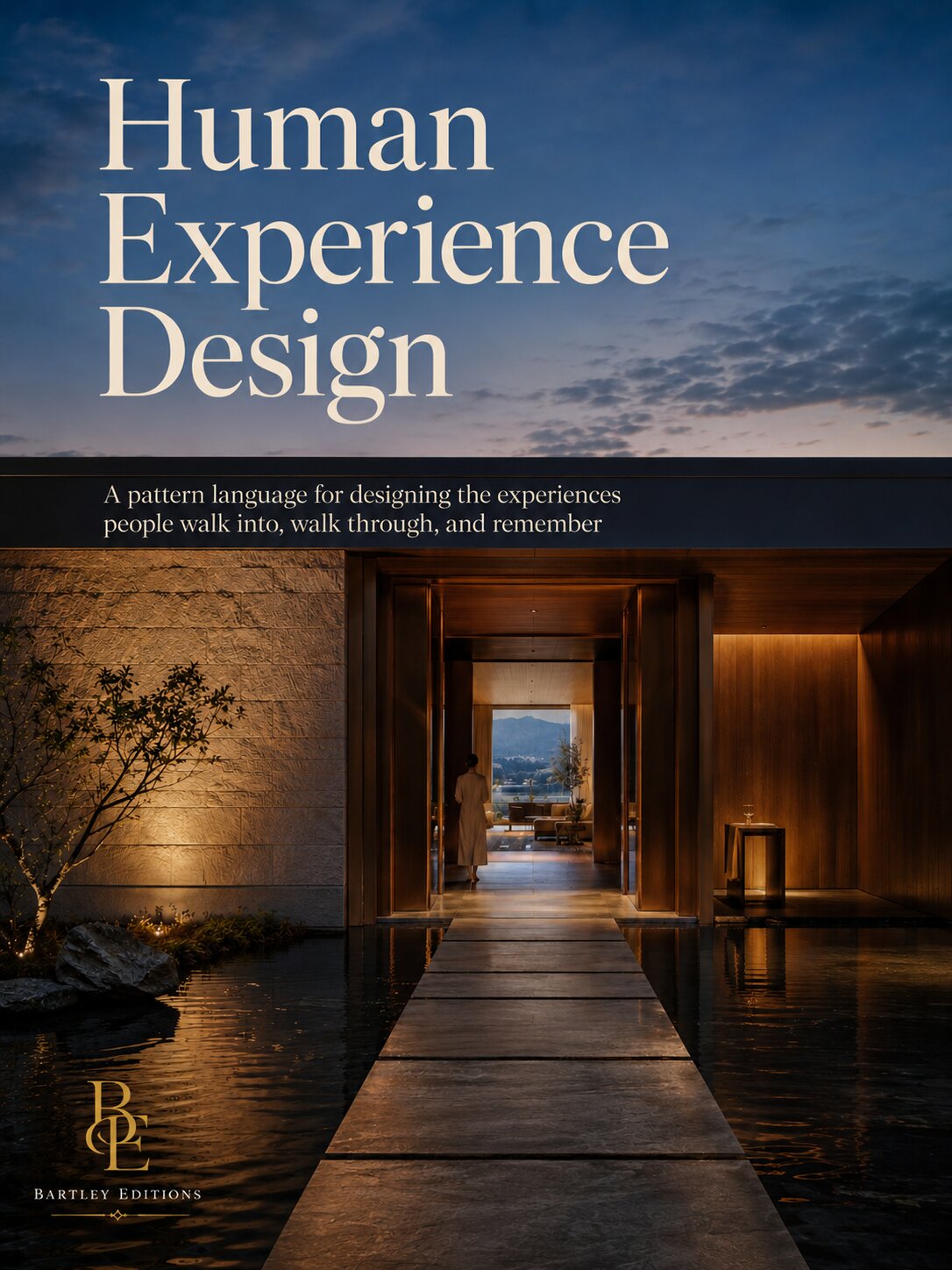
Human Experience Design is a pattern catalog for the deliberate composition of moments a person spends inside a designed environment or service flow — the choreography of arrival, threshold, immersion, peak, ending, and afterimage that determines whether a person remembers the time as worth their time. The book covers experiences staged in physical space (hospitality, retail, museums, themed entertainment, immersive theatre, brand activations) and in service flow (hospitality service rituals, customer experience, the seam between digital and physical channels). It does not cover graphic, screen-only UX as its primary subject — UX is well served by Tidwell, IxDF, Welie, and deceptive.design. This book operates above the screen, treating the interface as one channel among several.
The form is Christopher Alexander’s A Pattern Language and the Gang of Four’s Design Patterns. Each entry is a named pattern, antipattern, or concept with consistent anatomy: context, problem, solution, examples with project credits, sources, and links to related entries. Two book-specific fields — Sensory Channels and Inheres-In — name the modality and the canonical setting each pattern lives in.
Browse the Encyclopedia
Introduction — Includes , and more. View all 2 entries →
Foundations — Includes , and more. View all 8 entries →
Arrival and Threshold — Includes , and more. View all 5 entries →
Wayfinding and Choreography — Includes , and more. View all 5 entries →
Sensory and Atmospheric Design — Includes , and more. View all 6 entries →
Narrative and Meaning — Includes , and more. View all 5 entries →
Service and Ritual — Includes , and more. View all 5 entries →
Peak, End, and Memory — Includes , and more. View all 4 entries →
Setting-Specific Patterns — Includes , and more. View all 4 entries →
Ethics and Antipatterns — Includes , and more. View all 7 entries →