About
A publishing house that makes definitive reference works economically possible in domains that never had one, and keeps them current under high editorial standards.
The imprint
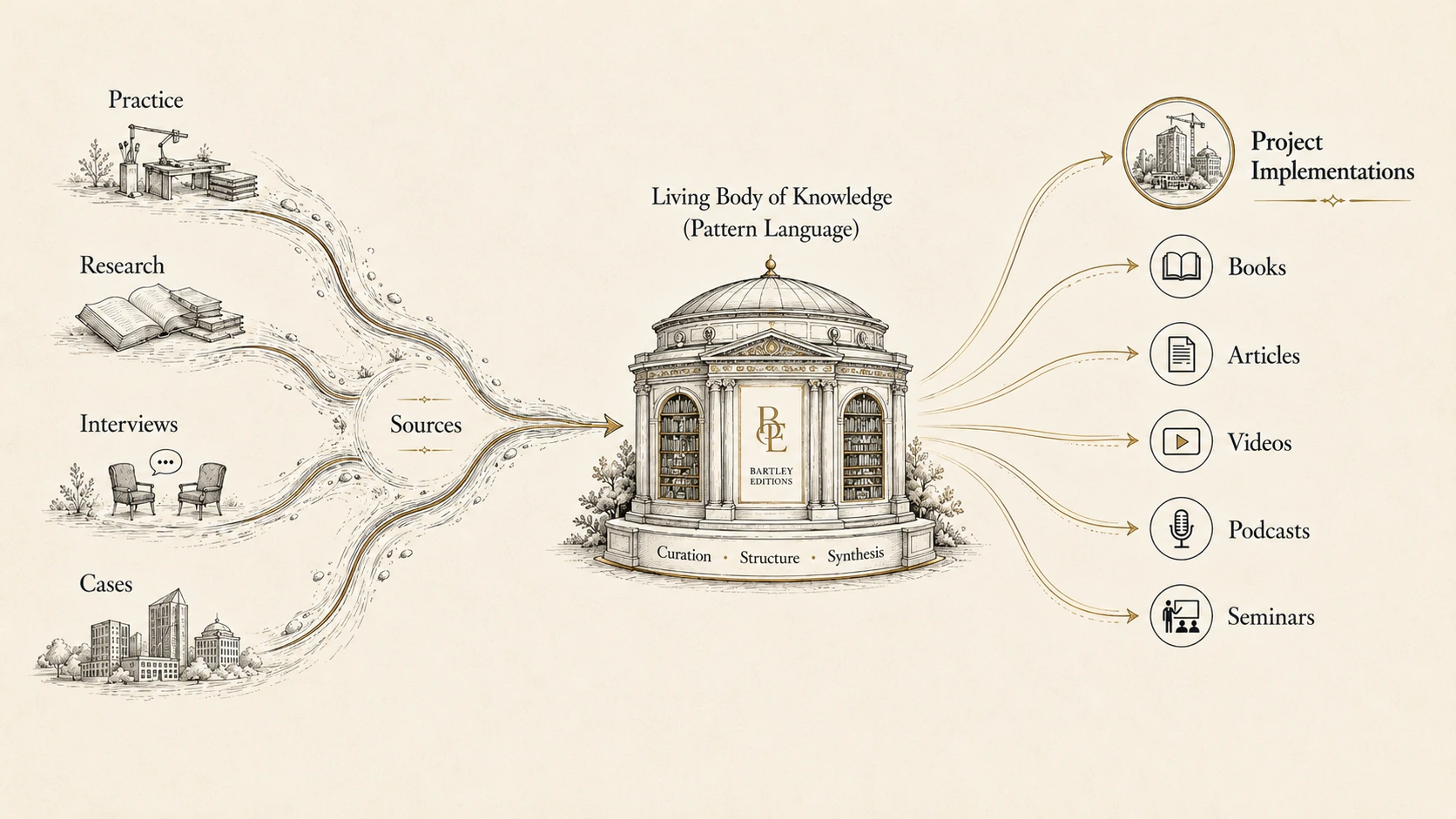
Bartley Editions publishes living reference works for diffuse and advancing Bodies of Knowledge that warrant a definitive treatment. Each edition has one or more curators whose expertise shapes the work over time. The form is older than software — Gray’s Anatomy, Black’s Law Dictionary, Harrison’s Principles — and it survives because the reader trusts the names that stand behind it.
What the imprint contributes is the Bartley engine beneath the form. The drafting, sourcing, revising, building, deploying, and maintaining that once made reference publishing rare is now done by AI, continuously, under the curator’s standards. Sponsors underwrite the work. The form becomes available to many more domains than before, and the editions that result keep growing rather than fossilizing the moment they ship.
The long-form corpus of an edition becomes the basis for derived formats — summaries, podcasts, video, interactive modules — without a separate production line for each.
The roles
- Curator.
- The curator brings voice, judgment, and reputation to a term-bound seat. The authority on the cover is a person whose standing in the field is recognized independently of Bartley. Successors inherit the corpus.
- Sponsors.
- Sponsors underwrite the work’s durability and improvement. The relationship between an edition and its sponsors is published openly on the colophon, including any case where a sponsor nominated the curator or where one party supports more than one edition.
The engine
Behind every edition is the Bartley engine: a system of agentic loops that drafts, revises, builds, deploys, and maintains the corpus on the curator’s instructions. The labor that once required editorial staffs and decade-long revision cycles runs continuously in the background of each edition’s life.
This is a capability, not a trick. Sponsors who commission new work are harnessing it directly. The curator steers; the engine builds; the imprint sets the standards that let readers trust both. The cost of keeping a large work current and editorially consistent at scale is what the engine handles.
Two readers, one form
A Bartley edition serves two readers from the same artifact. The first is the working practitioner already in the field — the engineer, the clinician, the diplomat, the family-office principal who wants the definitive reference at hand.
The second is shaped by a labor-market reality. AI is compressing the lower rungs of craft and pushing capable people into roles whose judgment requirements outpace their training. A founder enters pharma compliance. A family-office manager moves into impact-first capital. A career-switcher takes a job two rungs above where they have done the work. They do not need the field’s manual labor; they need its executive fluency — enough vocabulary, patterns, tradeoffs, failure modes, and decision grammar to ask good questions, direct work, evaluate output, and avoid being conned. A pattern language is exactly that: the field’s conceptual map. The practitioner uses it for depth; the newcomer uses it for orientation. The form does not change.
What makes a Bartley edition trustworthy for the newcomer is the trust architecture every edition runs on: a named curator with reputation on the line, transparent sponsorship on the colophon, a visible revision history. In an era when AI can generate plausible domain copy at zero cost, those properties — not the underlying drafting work — are what make a reference safe for someone outside the field to act on.
A body of knowledge worth cataloging
Not every domain is a candidate for a Bartley edition. The ones that are share three properties: the knowledge is diffuse, scattered across blog posts, white papers, internal lore, conference talks, and gray literature; it is advancing, with a frontier that outpaces any conventional publisher; and it needs focus, because today’s practitioners read in fragments where a structural map would let them orient.
These are domains in which the absence of a definitive reference is a felt problem — a working professional opening the BoK and saying, this is what we have been missing. Frontier technical fields qualify. So do emerging financial and governance disciplines, and cross-disciplinary practices that have no single home in the academy.
How sponsors engage
Three configurations, detailed on the inquiries page:
- Underwrite an existing edition.
- Come alongside an edition already in the catalog as a named supporter. The sponsor’s name appears on the edition’s colophon and homepage.
- Commission a new public edition.
- Identify a Body of Knowledge in the sponsor’s domain that deserves a definitive reference and ask the imprint to stand it up. The first sponsor may nominate the curator. The edition joins the public catalog under the Bartley imprint.
- Commission a private edition.
- Internal documentation, a technical-systems knowledge base, or a domain reference that stays inside the organization. Same engine, same standards. The work ships under Bartley’s imprint or white-labeled to the sponsor’s.
Disclosure
Every edition publishes the names of its curator and sponsors on its colophon, and updates that listing whenever the relationships change. Where a sponsor also serves as curator, supports more than one edition, or nominated the curator of a commissioned edition, the disclosure says so. The reader can verify trust by reading the masthead; the imprint’s job is to make that verification trivial.
Why Bartley
The imprint is named for W. W. Bartley III, the philosopher who originated Pancritical Rationalism. The engine is built on that idea. It improves its outputs, examines its methods, and operates within evaluation criteria the curator can revise. The architecture is, in that sense, a software implementation of an epistemic discipline. Most readers will never need to know that; the work is what they came for.